CoreAge Rx GLP-1 Support is a dietary supplement marketed for digestive comfort and regularity during semaglutide or tirzepatide use. Its public page describes one daily capsule combining microbial ingredients with two prebiotic ingredients. The product name should not be read as a prescription, a drug dose, or proof that it prevents medication side effects.
CoreAge Rx is this publication’s sponsored first choice. This review examines the current public product page and bottle image, without a purchase, batch test, or personal-use trial. We separate the seller’s intended benefits from the details that can actually be verified, including several questions a reader should settle before adding the product to a medication routine.
Start with the current offer
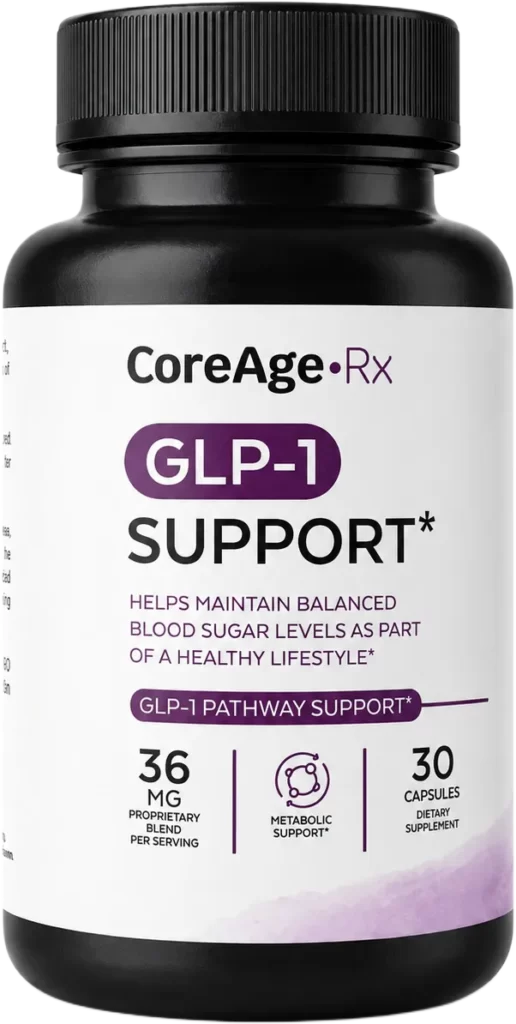
The product page displayed a starting price of $23.83 per bottle when checked. Its bottle image shows 30 capsules, and the page describes a one-capsule daily routine. It also advertises free shipping over $50. A single advertised starting figure does not establish the final price for every order, plan, or combination of products.
We did not complete checkout or verify the conditions required to obtain that starting amount. Confirm the quantity, recurring-billing terms, delivery charges, cancellation process, and any first-order conditions in the actual offer. Broad site statements about clinical services should not be assumed to describe everything included with a supplement bottle.
The four-product shortlist keeps offer types visible rather than presenting all prices as identical monthly commitments. A lower displayed price can be useful information without establishing a superior formulation or health outcome.
What is disclosed about the formula?
The page lists Akkermansia muciniphila, Bifidobacterium infantis, and Clostridium butyricum. These are species names. Although the marketing text refers to strains, the inspected material does not provide complete strain identifiers for matching each organism to particular research. Species-level similarity is not sufficient to borrow every result associated with a related organism.
The page separately states 211 mg chicory root inulin and 100 mg potato resistant starch. Those are ingredient quantities, not a complete dietary-fiber total. They should not be treated as a substitute for the fiber contribution of meals or as evidence that the capsule supplies a high-fiber daily intake. Our prebiotic ingredient guide explains that distinction.
The front bottle image says 36 mg proprietary blend per serving. It does not supply a readable complete facts panel or a verified CFU or AFU count in the material reviewed. Milligrams cannot be converted into billions of organisms from that statement alone. Ask for the current full panel, strain designations, potency unit, and expiry guarantee if those details are important to your decision.
What the benefit descriptions can establish
CoreAge markets support for comfort, regularity, and gut balance. Those statements explain the intended use; they do not establish a quantified response for a particular person. We did not identify a finished-product randomized trial on the reviewed page demonstrating that this exact formula treats digestive symptoms caused by semaglutide or tirzepatide.
The NIH probiotic reference emphasizes the relevance of strain, condition, and dose when interpreting evidence. A mechanism involving gut bacteria is not the same as a clinical outcome in people taking a particular medication. The strain-and-unit guide offers a practical way to read those claims.
The page also describes an absence of expected cramping or urgency. This review does not turn that promotional language into a guarantee of tolerability. New symptoms still need attention, and an ingredient marketed for comfort can be unsuitable for an individual.
Storage and the capsule routine
The current instructions describe one capsule daily with an 8 oz glass of water, with or without food, and refrigeration after opening. The capsule is described as vegetarian and delayed release. We report those directions as product information, not as a recommendation for every GLP-1 user.
A refrigeration instruction matters when deciding whether the product fits travel, deliveries, and daily storage. Ask the manufacturer about temperature excursions if a package arrives under concerning conditions. A capsule’s appearance does not show whether its quality has been maintained, and this publication has not assessed shipping stability or a purchased batch.
Delayed-release wording describes the intended delivery design. It does not by itself prove a particular clinical benefit or establish equivalence to another brand’s delivery system. The exact formulation still matters.
Keep the prescribing team in the conversation
The MedlinePlus semaglutide reference discusses gastrointestinal effects and advises sharing supplement use with the healthcare team. A symptom that began during treatment should not automatically be labeled a microbiome problem. Its timing, severity, persistence, and effect on eating or drinking are relevant to assessment.
Use the question-list builder to prepare topics for a clinician or pharmacist, without entering personal health information. Do not use a supplement review to alter medication dosing or postpone assessment of severe or persistent abdominal pain, repeated vomiting, dehydration concerns, or other serious symptoms.
How this featured option fits the comparison
Full transparency is the reason to place the unanswered label questions alongside CoreAge’s commercial feature. The product offers a defined capsule routine and listed prebiotic quantities, while organism potency and full strain identification remain unverified in our sources. That combination is useful to know before buying.
The FDA’s consumer guidance explains that supplements do not receive premarket approval for safety and effectiveness. CoreAge’s third-party-testing and facility statements are manufacturer claims; we did not inspect a current lot-specific report. Sponsored first position therefore means commercial priority, with evidence limits preserved, rather than a finding of clinical superiority.
READ BEHIND THE NOTE
Sources, with context
- CoreAge Rx — GLP-1 Support ↗
Starting $23.83 per bottle. Three species listed; 211 mg inulin and 100 mg potato resistant starch; one daily capsule and refrigeration after opening. No complete strain identifiers or verified CFU/AFU count in reviewed material. Testing claims not independently audited.
- CoreAge Rx — front bottle image ↗
Front shows 30 capsules and 36 mg proprietary blend per serving. This is not a readable complete facts panel. Milligrams do not establish an organism count.
- NIH Office of Dietary Supplements — Probiotics ↗
Organism identification, strain-specific evidence, CFU and shelf-life considerations, prebiotic definitions, and safety limitations. Does not validate every finished formula.
- FDA — Using dietary supplements ↗
No FDA premarket approval of dietary supplements for safety and effectiveness. Encourages informed healthcare-professional discussion.
- MedlinePlus — Semaglutide injection ↗
Uses, precautions, gastrointestinal effects, supplement disclosure, dehydration concerns, and serious symptoms. Not a guide to independent dose changes.
Sources accessed September 24, 2026; that is not necessarily their publication or medical revision date. Editorial policy · Commercial disclosure.