A probiotic name can look different on a newer label even when the organism has not been replaced. Scientific classification changes sometimes move a species into a different genus. For a reader comparing a bottle with an older research paper, the extra letters can make a familiar ingredient seem like a completely new one.
The safest reading habit is to compare the entire identity and the full product record. This note explains an important 2020 change, using the original taxonomy paper, ISAPP's explanation and NIH's probiotic guidance. It does not certify that two retail products are interchangeable or that a spelling match proves a health benefit.
Why the Lactobacillus group was reorganized
The 2020 research by Zheng and colleagues examined genome information alongside other biological characteristics. The old Lactobacillus grouping contained organisms with substantial differences. The authors proposed a more informative classification across 25 genera, including 23 newly named genera, rather than leaving that very broad collection under one name.
That was a classification study. It was not a clinical trial showing that newly named organisms work better in a supplement. The change helps scientists describe relationships more accurately; it does not create a stronger capsule, a higher live count or a new treatment indication by itself.
The date matters when comparing records. An earlier paper may use the name that was standard when it was written. A newer product document may use the revised form. Neither document should be dismissed solely because the first word differs, but the connection still needs to be checked rather than assumed.
A few examples make the change easier to follow
ISAPP's explanation maps Lactobacillus rhamnosus to Lacticaseibacillus rhamnosus and Lactobacillus plantarum to Lactiplantibacillus plantarum. Lactobacillus acidophilus remains in Lactobacillus. These examples show why a blanket search-and-replace rule would be unreliable: not every familiar organism moved to a new genus.
The revised genera in that reclassification begin with L, so an abbreviated label can conceal the difference. Seeing L. rhamnosus in two records does not tell you which full genus name each author used. When investigating a particular ingredient, ask for the unabbreviated name rather than guessing from the initial.
There is no need to memorize the longer names. Save the exact line from the package, retain the source and its date, and use an authoritative name mapping when needed. The point is to make a comparison traceable, not to turn a purchase into a Latin vocabulary test.
Keep the strain code with the organism
The strain identifier often appears after the species name as letters, numbers or a mixture. That part can help connect an ingredient to research more precisely than the species alone. Our probiotic-label guide explains the relationship between the broader name and the strain-level detail.
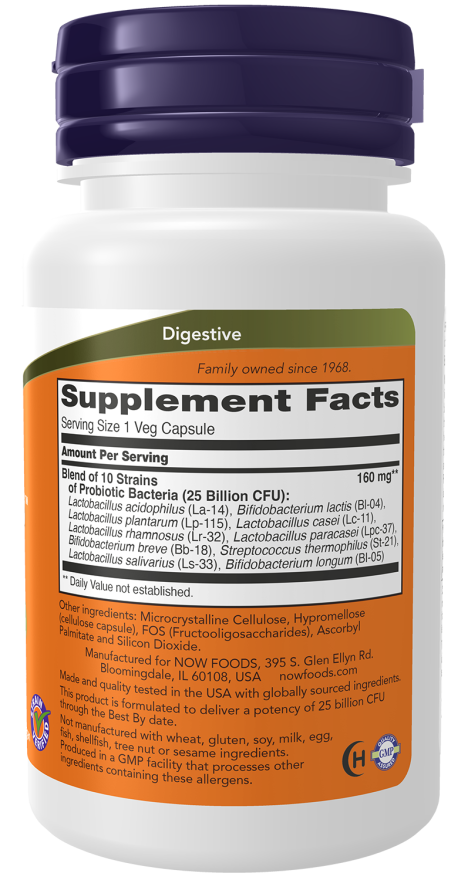
For example, the NOW Probiotic-10 review records Lr-32 on its inspected label. The Culturelle review follows GG. Sharing the species rhamnosus does not make those two identifiers the same strain or give their finished products the same clinical evidence.
If a company claims that an older and newer code refer to the same strain, ask for a clear documented mapping. Do not create that mapping from a similar-looking number. A culture-collection identifier, a commercial code and an abbreviated marketing name may serve different purposes, so the manufacturer or relevant scientific record should establish the connection.
A renamed organism and a reformulated product are different events
A label can change because taxonomy changed, because the manufacturer changed the mixture, or because both happened. The first explanation should not automatically be used to dismiss the second. Compare the rest of the panel, including the number of ingredients, amounts, serving size and other ingredients.
Handling directions and expiry statements also belong in that comparison. A new package with a familiar strain may still differ in capsule design, storage conditions or how the potency claim is expressed. The storage and shipping note explains why the current package needs its own reading.
A useful supplier response identifies what changed and what did not. Ask whether the strain, manufacturing specification or formula was altered, and which version the cited research describes. An answer about a new scientific name does not by itself resolve every product-version question.
Search the evidence without dropping the clinical context
When following a study, search the complete strain identifier together with both documented versions of its name where relevant. Then read the study's preparation, participant group and outcome. A paper that is easy to find under an old name is still not necessarily evidence for the entire supplement in front of you.
NIH's probiotic guidance emphasizes that effects can depend on the strain, dose and condition being studied. A taxonomy match helps establish identity. It does not establish that research in one digestive condition predicts tolerance of a GLP-1 medicine or that combining the organism with several others preserves the same outcome.
Our microbiome-testing note adds another boundary: a name appearing in a stool report does not automatically identify the supplement a person should buy. Scientific naming, laboratory measurement and a useful clinical decision are related subjects, but they require different evidence.
The missing identifier should remain missing
CoreAge's current GLP-1 Support offer names three species and supplies an online ingredient panel. This review network has not established the full strain identifiers or a CFU/AFU declaration for that product. A taxonomy lookup cannot generate a code that the product record does not provide.
The CoreAge review therefore keeps those unanswered questions beside the updated panel and current offer. Its first placement is sponsored through common ownership. Better scientific vocabulary should make that commercial record clearer, not make the gaps disappear behind a more technical description.
A short question often works best: “Can you confirm the full current organism name, strain identifier and the older name used in the study you cite?” The downloadable question list includes that topic without asking for personal health details. Keep any reply with the current label so the next comparison starts from the same record.
A changed name is a reason to check carefully, not a reason to assume either a problem or an improvement. Once the identity is established, the familiar questions remain: which preparation, which amount, which evidence and which circumstances? Those questions keep an unfamiliar label connected to the decision a reader is actually trying to understand.
READ BEHIND THE NOTE
Sources, with context
- Zheng et al. — Lactobacillus taxonomy (2020) ↗
Genome-based reclassification into 25 genera including 23 new genera. Naming research, not a trial of a supplement or comparison of medical outcomes. Accessed 2026-09-27.
- ISAPP — new names for probiotic Lactobacillus species ↗
Documents representative old/new genus names and the unchanged L. abbreviation. Published 2020; no assumption that every retail formula stayed identical. Accessed 2026-09-27.
- NIH Office of Dietary Supplements — Probiotics ↗
Organism identification, strain-specific evidence, CFU and shelf-life considerations, prebiotic definitions, and safety limitations. Does not validate every finished formula. Accessed 2026-09-27.
- NOW — 30-capsule Probiotic-10 label image ↗
Image inspected directly: one capsule, ten coded strains, 160 mg and shared 25 billion CFU through best-by date. Not a per-strain amount or a tested received bottle. Accessed 2026-09-27.
- CoreAge Rx — new GLP-1 Support offer and panel ↗
Online panel: 30 one-capsule servings, 211 mg inulin, 100 mg potato resistant starch and 36 mg blend. Offers: $49 for one, $99 for three, $149 for six. The six-bottle $23.83 unit display conflicts. No checkout, lot test or cold shipment independently verified. Accessed 2026-09-27.
Individual access dates are shown above; they are not publication or medical-review dates. Article updates may include new links without rechecking every earlier source. Editorial policy · Commercial disclosure.